





How to Measure Your Fireplace for Glass Doors (Inside Fit vs Overlap Fit)
Ordering custom fireplace doors comes down to one question that stops most people cold: "What if I measure wrong?" It's a fair fear. A door that's a half-inch too wide won't sit right, and a door that's too small leaves a gap you'll stare at every winter. The good news: measuring is genuinely simple once you know which numbers matter, and at ExceptionalFire every custom order is checked by a human before anything is cut. Here's exactly how to do it.
What you'll need
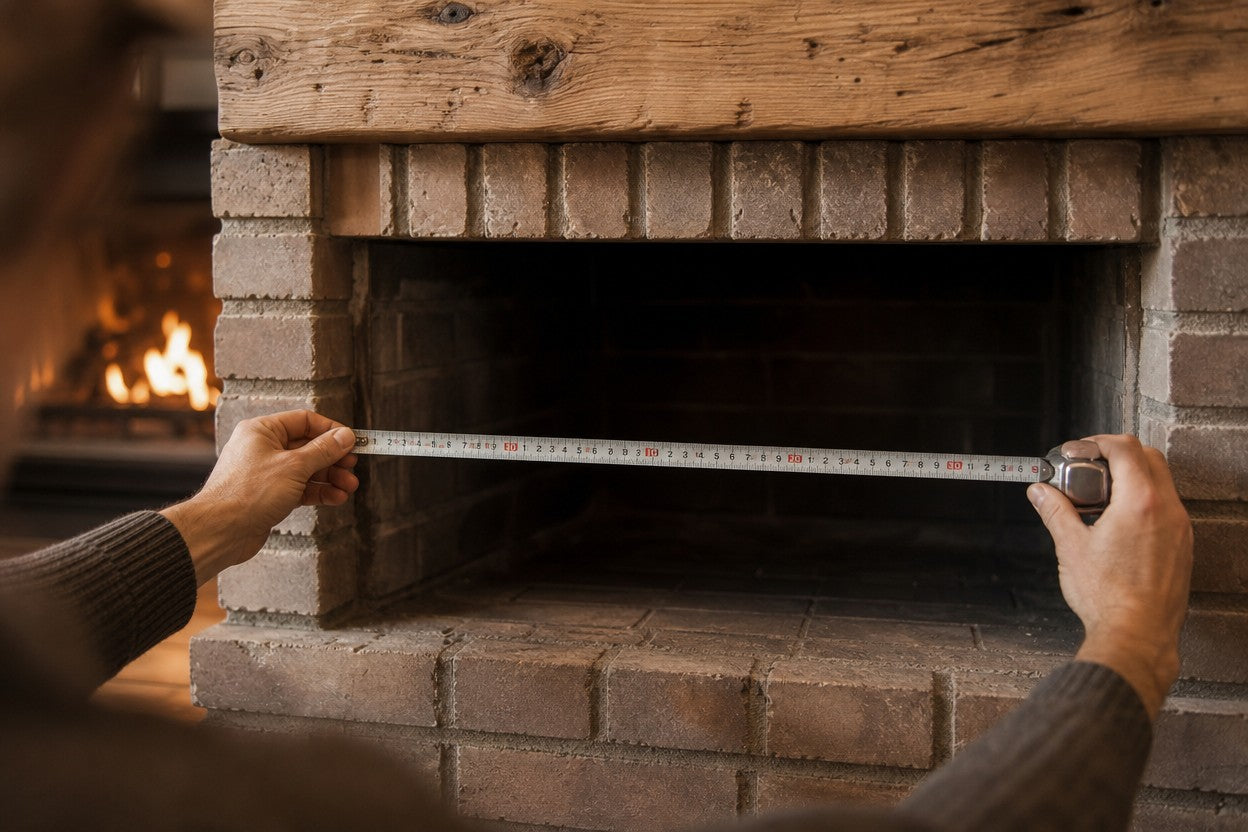
Grab a steel tape measure (cloth tapes stretch and lie), a pencil, and a piece of paper. Skip the laser measure for this job — fireplace openings are rarely perfectly square, and you need to physically reach the brick. Five minutes is all it takes.
One rule before you start: measure to the nearest 1/8 inch, and never round. If the opening is 35‑7/8", write 35‑7/8", not 36". Those small differences are exactly what a custom door is built to honor.
Inside fit vs overlap fit — the choice that decides everything
Before you measure, understand the two ways a glass door can mount. This single decision changes which measurements matter and how your finished fireplace will look.
Inside fit (recessed mount)
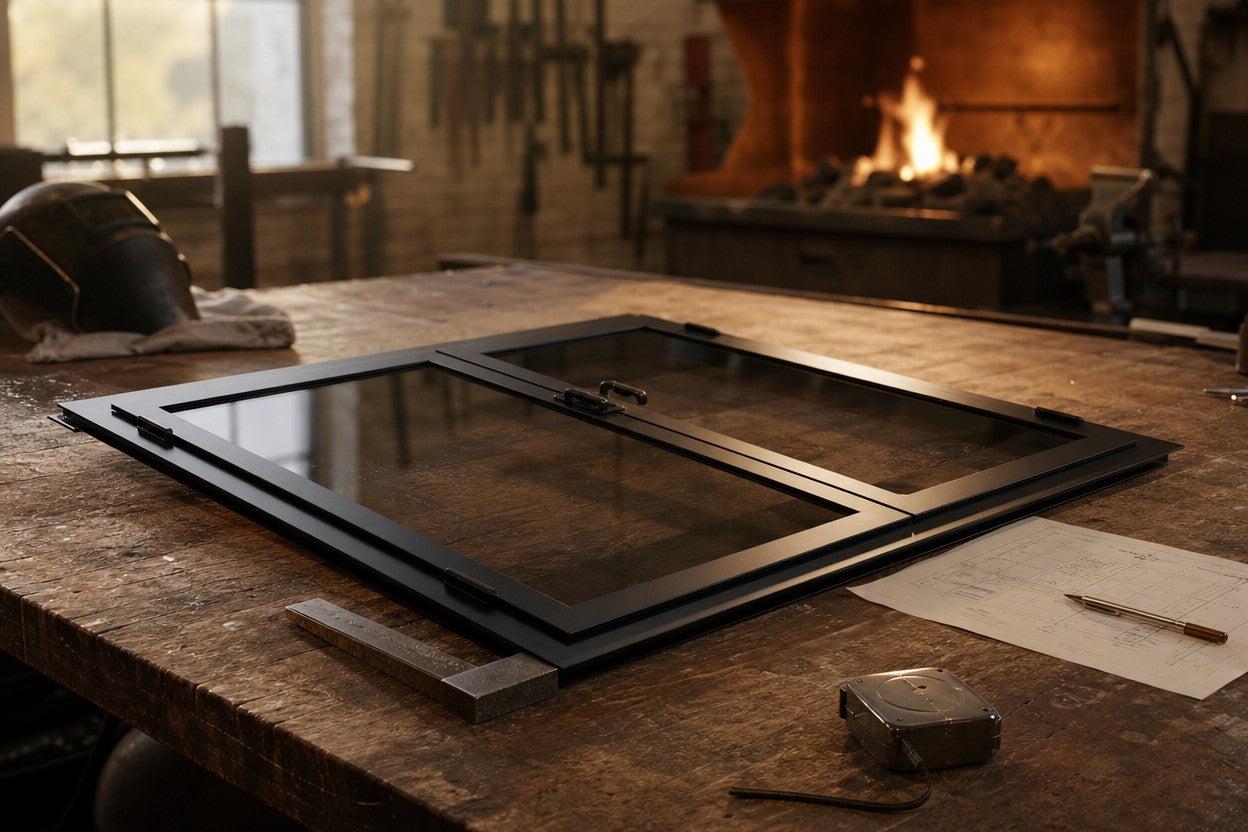
The door frame sits inside the fireplace opening, tucked into the firebox so the brick or stone face stays fully visible around it. This is the cleaner, more architectural look and the right choice for masonry fireplaces — those built from real brick or stone, typically site‑built. Because the door lives inside the opening, the depth and squareness of your firebox matter, and the door must be built slightly smaller than the opening to slide in.
Overlap fit (overlap mount)
The door frame is built larger than the opening and sits on top of the surrounding face, overlapping the edges like a picture frame. This hides uneven or chipped opening edges and is the standard for prefab fireplaces (also called zero‑clearance or factory‑built — a metal firebox installed in a wood-framed chase). Overlap fit is more forgiving of an imperfect opening, which is why it's so common.
Not sure which you have? If you can see a continuous metal lip or refractory panels and the unit looks factory-made, it's almost certainly prefab → overlap fit. If it's solid masonry brick all the way in, it's masonry → inside fit is usually best. When in doubt, our configurator asks a few guided questions and recommends the right mount for you.
How to measure width (front and rear)
Width is where most fit problems start, because fireplace openings taper — they're often narrower at the back than the front. That's why we ask for two width numbers.
- Front width: Measure left to right across the very front of the opening, flush with the face of the fireplace.
- Rear width: Reach to the back of the firebox and measure left to right there. On a tapered masonry opening this will often be 1–3 inches narrower.
- Check three heights: Take the front width at the top, middle, and bottom. Openings settle and bow over the decades. Write down the smallest front width — your door has to clear the tightest point.
For overlap fit, the rear width matters less, but the front width and the flat face area around the opening matter a lot — you need enough clearance for the frame to seal against. For inside fit, both front and rear widths drive how the door is built to slide in and sit flush.
How to measure height
Measure vertically from the floor of the firebox to the top of the opening, on the left side, the center, and the right side. Just like width, record all three — and note the smallest. Many masonry fireplaces have a lintel (the steel or stone bar spanning the top of the opening) that hangs slightly lower than the surrounding brick. If a lintel intrudes, measure to the lowest point it reaches. Your door is built to fit the real opening, lintel included.
Don't forget depth and clearances
For inside fit especially, measure the depth of the firebox — front edge to back wall — so the door frame and any handles have room without hitting grates or gas logs. Also note anything that lives in front of the opening: a raised hearth, a mantel leg, trim, or a gas key valve. These can affect door swing and handle placement. A quick photo of the whole fireplace is worth a hundred words here.
Write it down like this
- Front width (smallest of top/middle/bottom): ____ in
- Rear width: ____ in
- Height (smallest of left/center/right): ____ in
- Depth: ____ in
- Fireplace type: masonry / prefab
- Lintel or obstructions: yes / no — describe
That's the full picture. Enter those numbers into the configurator and it handles the rest — including the small, deliberate size adjustments a craftsman makes so the door fits and operates correctly. You never have to do the "subtract for clearance" math yourself.
The safety net: your free Expert Fit Review
Here's the part that should put the fear to rest. Every custom door order at ExceptionalFire goes through a complimentary Expert Fit Review before it's built. A real fireplace specialist looks over your measurements, your fit type, and your photos, and flags anything that looks off — a tapered opening, a lintel, a depth that's too shallow for a certain handle. If something doesn't add up, we contact you before a single piece of steel is cut.
This is why our customers order custom with confidence: the responsibility for getting the fit right is shared with experts who do this every day, not left entirely on your tape measure. It's also what separates a true custom door house from a catalog that just ships you a box and wishes you luck.
Frequently asked questions
What if my opening isn't perfectly square?
That's normal, especially on older masonry. Always record the smallest width and height, and our team accounts for the variation. An out-of-square opening is exactly the kind of thing the Expert Fit Review is designed to catch.
Can I do an inside fit on a prefab fireplace?
Usually not — prefab fireboxes are built for overlap-mount doors that attach to the face, and the manufacturer's clearances must be respected. If you have a prefab unit, overlap fit is almost always the safe, correct choice.
How much smaller is an inside-fit door than my opening?
A small, intentional amount, calculated for your specific door so it slides in and seals properly. You don't need to subtract anything yourself — give us the true opening dimensions and we build to fit.
What if I'm still nervous about measuring?
Send us photos with a tape measure in frame. We'll confirm your numbers, or walk you through it on a call. Reassurance is part of the product.
%0A%20%20%20%20Ordering%20custom%20fireplace%20doors%20comes%20down%20to%20one%20question%20that%20stops%20most%20people%20cold:%20%22What%20if%20I%20measure%20wron...)