Skip to content

Glass Mantel Shelves

Tempered-glass floating shelves1 mantels From $250

Floating glass mantels for ultra-modern interiors — clear, frosted, or back-painted finishes.

4.9 · 560+ reviews 12,000+ fireplaces served
Here to Help — Since 2014

Real People. Real Expertise. Every Order Reviewed.

Family-owned in Laguna Hills, California since 2014. Every custom order gets a real human fit review before production — so if something's off, we catch it. Questions before you buy? That's literally what we're here for.

Daniel Zajac

Daniel Z.

Senior Fireplace Specialist

10+ Years Experience

"Send me a photo of your fireplace. I'll tell you exactly what fits and why."

Beata Soja

Bea S.

Product Specialist — Masonry & Prefab

10+ Years Experience

"Not sure if yours is masonry or prefab? I can tell in about 30 seconds on a call."

Robert Soja

Robert S.

Fireplace Specialist & Technician

10+ Years Experience

"If your fireplace is unusual — arched, oversized, odd brick — that's my table."

Kendall Soja

Kendall S.

Order Concierge — Shipping & Warranty

Support Team

"I track your order from production to your doorstep. Anything weird, call me first."

Usually replies within 15 minutes during business hours.

Mon–Fri 8am–5pm PST · Sat 9am–2pm PST
Glass Mantels Guide

Glass Mantel Shelves — Tempered, Modern, Floating

Read the full guide

What is a non-combustible mantel?

A non-combustible mantel is built from materials that won't ignite, sustain combustion, or release flammable gases at typical fireplace temperatures — steel, cast concrete, tempered glass, or steel with a printed wood-grain finish. Most US jurisdictions follow the International Residential Code (IRC R1001.11), which restricts combustible mantels (real wood, MDF, composite) to a minimum 12-inch clearance above an operating fireplace. Non-combustible mantels can install closer — typically 6 to 8 inches above the firebox opening — and bring lower long-term risk of warp, char, or finish failure under heat cycling.

Every mantel in our catalog is non-combustible by design. We don't sell real-wood mantels because the warranty exposure is too high and most local codes don't permit them above active fireplaces.

The four materials we offer

Steel — powder-coated, made in the USA

14- to 16-gauge cold-rolled steel hollow box, sandblasted, primed, and powder-coated at 400°F in our facility. Internal ribbing prevents flex on long spans (60-inch+ shelves stay straight under 30+ lbs of load). Standard finishes: matte black, oil-rubbed bronze, antique pewter, brushed nickel — plus 21+ premium and plated options. Heat-stable, non-flammable, and repaintable if a future remodel demands a different color. Typical price: $895–$1,400 in standard sizes.

Wood-grain steel — wood look, full code compliance

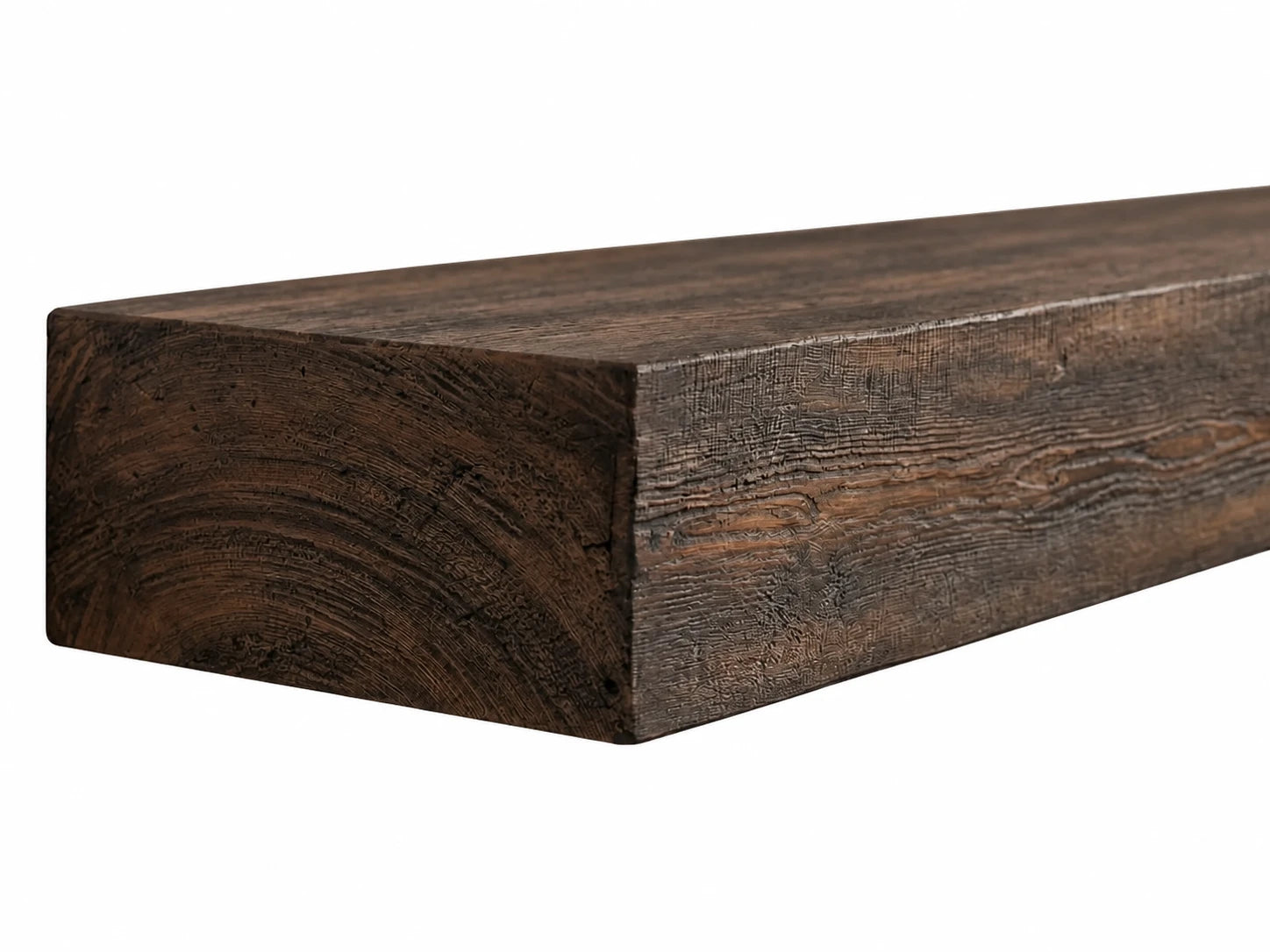
The same steel substrate, but the visible face carries a hot-press polymer transfer of high-resolution real-wood imagery. Oak, walnut, cherry, hickory, maple, and reclaimed barnwood are stocked. From 3–4 feet away the visual is indistinguishable from real lumber; touch reveals the cooler hardness of metal. UV-stable for 15–20 years indoors. Ideal for buyers who want the warmth of wood aesthetics without the code restrictions or maintenance overhead. Typical price: $945–$1,500.

Cast concrete — modern industrial

Glass-fiber-reinforced concrete (GFRC), the same structural mix used in countertops and architectural panels. Real concrete look and feel at half the weight per cubic foot of solid stone. Heat-stable to 800°F continuous and resistant to spalling at code-compliant clearances. Available in natural gray, light tan, charcoal, black, and white — plus custom integral colors on request. A 60-inch concrete shelf weighs 80–130 lbs and anchors with concealed lag bolts into wall studs. Typical price: $1,200–$2,200.

Tempered glass — minimalist floating shelf

3/8-inch tempered safety glass (ANSI Z97.1) with flat-polish edges. Available in clear, smoke (gray-tinted), bronze, and acid-etched frosted; painted-back glass is also possible in custom colors. Mounted on a hidden powder-coated steel channel that anchors to wall studs — from the front, no hardware is visible. Tempered glass handles 470°F sustained, so at code-compliant heights (12+ inches above the firebox) cracking from heat alone is essentially impossible. Typical price: $1,100–$1,950.

How to measure for a mantel shelf

You need three numbers: width, depth, and height above the firebox opening. Width is the visible length you want spanning the wall — most shelves extend 4–6 inches past each side of the firebox surround. Depth is how far the shelf projects out from the wall (typically 6–8 inches; concrete and oversized steel can go to 10–12). Height is the gap between the top of the firebox opening and the underside of the shelf — minimum 6 inches for non-combustible mantels per most local codes, 12+ for any combustible material.

If your wall has tile, stone, or stacked-stone veneer, also note the depth of the cladding so the mounting cleat sits flush. Send photos through the contact page if anything's unclear and a specialist will confirm before we cut steel.

Mounting — hidden cleat vs. through-bolt

Hidden steel cleat (default for steel and wood-grain): a wall-mounted metal bracket anchors into studs; the hollow mantel slides over the cleat and locks with set screws. From the front, no hardware is visible. Plan 30–60 minutes for the install with a stud finder, level, drill, and 1/4-inch bit. Mantels over 60 inches benefit from two-person handling.

Through-bolt (concrete, oversized, or masonry walls): concealed lag bolts pass through the mantel into wall studs or masonry. Drill the wall first, dry-fit the mantel, mark the bolt locations, then mount. Masonry walls add a hammer drill and 1/4-inch masonry bit to the toolset. Total install time: 60–90 minutes for one person, 30–45 with two.

Every mantel ships with the matching hardware pack, a paper template, and step-by-step printed instructions.

Code requirements above an active fireplace

The International Residential Code (IRC R1001.11) governs mantel clearances for masonry fireplaces in most US jurisdictions. The exact rule depends on the mantel's projection from the wall — but a common shorthand is: combustible mantels need at least 12 inches of clearance above the firebox opening; non-combustible mantels can install as close as 6 inches with manufacturer guidance. Check your local building department before installation; some California and Pacific Northwest counties enforce stricter rules.

Prefab (zero-clearance) fireplaces follow the manufacturer's listed clearances, which are often more permissive because the firebox is engineered as a heat-isolated unit. Send your fireplace make and model and we'll confirm what'll fit.

Lead times and ordering

Standard sizes (48, 60, 72 inches) in the four highest-volume finishes ship in 5–10 business days. Custom sizes and premium finishes build in 21–30 business days. Concrete mantels, painted-back glass, and color-matched powder coats run 4–5 weeks. Free freight shipping in the continental US on every order.

Every order is reviewed by a human before production — if your dimensions or fit type look off for the room, we email within one business day. Schedule a 15-minute call from the contact page if you'd rather walk through it together.

Frequently Asked Questions

Is the glass tempered?

Yes — every glass mantel uses tempered safety glass to ANSI Z97.1. If it ever breaks (rare with proper installation), it shatters into rounded pebble fragments rather than sharp shards. Annealed glass is never used for mantels.

Does the glass crack from fireplace heat?

Tempered glass handles 470°F sustained. Mantels installed at code-required clearances (12+ inches above the opening) experience much lower temperatures — typically 90-130°F during a burn. Cracking from heat alone is essentially impossible at code-compliant heights.

How thick is the glass?

3/8 inch standard. Optional 1/2 inch for oversized mantels (over 60 inches). Edge treatment is flat polish on all four sides. Beveled and pencil-edged options available on premium lines.

What colors does glass mantel come in?

Clear, smoke (gray-tinted), bronze (warm brown), and acid-etched frosted. Painted-back glass is available in custom colors — paint applied to the back face, visible through the front, fully sealed and impervious to fireplace heat.

How does a glass mantel float on the wall?

Hidden steel mounting cleat. The cleat anchors to the wall studs; the glass rests in a powder-coated steel channel that slides over the cleat. From the front, no hardware is visible — the mantel appears to float.

Is glass mantel safe with kids?

Tempered glass is shatter-resistant, not impact-proof. Hard impact from a heavy object (a child swinging a toy bat into the corner) could break it. The shards are safer than annealed but not invisible. Consider concrete or steel mantels for high-impact homes.

Ready to find your match?

Talk with a fireplace specialist — free 15-minute consultation.